



How to avoid breaking Stone CNC Router bits


I broke my CNC router bit – How did that happen?
A customer of mine called yesterday stating that the CNC Router bit he uses regularly just broke.
Why? It could be due to a manufacturing defect, but that is not very likely.
I then asked him to explain what work he was doing with his CNC machine when the breakage occurred.
He was working on granite making just 1-millimeter deep cuts into the stone (in fact this customer usually goes much deeper, cutting 4 or 5 mm deep each pass!)
Then I asked him how he had inserted the bit into the ER collet.
At this point, I had him send me a photo of the collet as it was used.
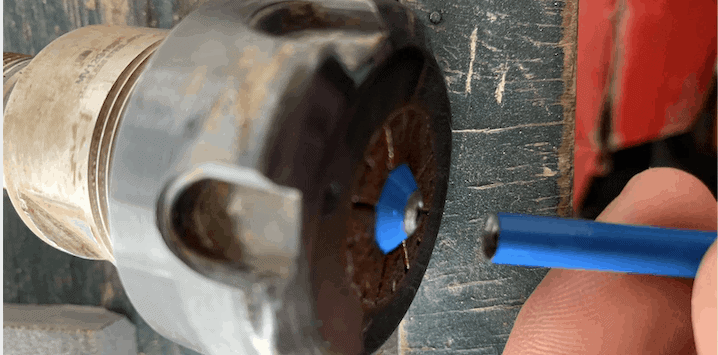
This is the actual scenario:
- He was working on a very hard material;
- He was working with a 9-cm long granite bit inserted just a few centimeters into the ER collet;
- The ER collet he was using was very rusty and worn;
- He had set a cutting depth of 1 mm for each pass;
The bit didn’t break because of a manufacturing defect but due to vibrations. With a rotational speed of 8000 rpm, the excessive vibrations ended up breaking the bit in the shank even though it appeared to be working well and was not making any unusual noise.
The bit vibrations (as often happens) had more than one cause.
- The bit had not been inserted as far as it could go into the collet and was therefore very long.
- The collet did not form a stong grip being that it was already rusted and worn. Thus the grip was poor and caused the bit to rest crookedly in the collet.
- The cutting depth was too short and failed ot exploit the material’s capacity to dampen vibrations. In this case, making shallow cuts was not a benefit, but a problem for the router bit.
To use the bits as best as possible, prevent premature wear and breakage, to the extent possible, vibrations must be minimized.
- Make sure that the ER collet is in good condition and not overly worn.
- Work with a router bit as short as possible to minimize leverage acting on it while cutting. The bit is inserted into the ER collet to a greater or less depth depending on the work you are doing (sett the photo below)
- When cutting very hard materials, such as granite or marble, make sure you make deeper passes to the vibration-damping effect of the material itself.
Reduce the feed by half and double the cutting depth of each pass.

In this way you can reduce the vibrations and the probability of your router bit breaking.


















 Diamond Blades
 Blade for power cutters, masonry saws and floor saws
 Polishing Machine Tools for Stone, Marble and Granite
 Antiquing Brushes
 Edge polishing abrasives
 Edge polishing diamonds
 Abrasive plateaux
 Fickert-Frankfurt abrasives
 Texture tooling
 Adhesives and glue
 CNC Diamond Stone Tools
 Ceramic, Granite and Marble Drill Bits
 Diamond Cloths
 Stone fabrication accessories
 Stone Carving Tools for Sculpting Marble and Granite
 Diamond Wires for Granite and Marble Quarries
 Portable Router Tools Handheld Bits
 Cemetery and Mausoleum Accessories
 Measuring Tools
 Sink and Worktop Mounting Components
 Tileable Stainless Steel Sinks
 Waste Kits
 Basin Brackets
 Fixing Systems
 Tile cutters
 Electric Tile Cutters
 Large Slab Handling
 Rail Tile Cutters
 Vibrating Suction Cups
 Alignement Suction Cups
 Tiling Accessories
 Grouting Tools
 Mixers
 Tileable Components
 Worktables
 Tile Levelling
 Montolit Spare Parts
 CNC Glass Tools
 CNC Wood Tools
 CNC Vacuum Cups
 CNC Tool Holders
 CNC Tool Forks
 CNC Adapters and Tool Extensions
 CNC Sensors and Measuring Tools
 Positioning Alignment Lasers
 Polishing Pads for Angle Grinder
 Sanding discs for angle grinders
 Angle Grinder Cutting Blades
 Diamond Core Drill Bits
 Grinding Cup Wheels
 Diamond Profile Wheels
 Backing Pads
 Grinder Dust Guards
 Angle Grinder Accessories
 Material Handling
 Slab Vacuum Lifters
 Lifting Clamps
 Manual Lifting Suction Cups
 Slab Trolleys
 Miter Clamps
 Handling Equipment Parts
 Manzelli Spare Parts
 Grabo Spare Parts
 Power Tools
 Grinders
 Polishers and Angle Sanders
 Rotary Multi Tools
 Power Drills
 Multi Tools Accessories
 Power Tool Batteries
 Power Tool Cases
 Masonry Equipment and Machines
 Machinery
 Submersible Pumps
 Vacuum cleaners
 Spare parts
 Electrical Spare Parts
 Filter-presses and Sludge Dehydration Systems Parts
 Cutting Table Mat and Panels
 Wire Saw Parts
 Water Cooling Pipes
 Personal Protective Equipment
 Packaging
 Floor Pads
 Floor Brushes
 Polishing Powder
 Floor Diamond Resin Tools
 Floor Machines
 Floor Machine Accessories Spare Parts
 Protective
 Detergents
 Waxes and Finishing